
Website Takedown Solutions: A 2026 Guide to Removing Phishing, Scam, and Fake Sites
🛡️ Fake Website Impersonating Your Brand? 24–72 Hour Takedown
Get a free case assessment with a detailed strategy and quote within 2 hours. 15+ platforms covered, registrar and CDN escalation included.

Website Takedown Solutions at a Glance
Website takedown solutions are managed or automated services that remove phishing, scam, fake, and impersonation websites by submitting abuse reports, DMCA takedown notices, and trademark claims to registrars, hosts, CDNs, and search engines. Professional providers report median takedown times between 33 minutes and 24 hours, with success rates of 92% to 99%. Typical per-case costs range from $150 to $1,500, while enterprise subscriptions run $1,500 to $10,000 per month. Removal.buzz completes most website takedown cases within 24 to 72 hours with a flat per-case fee and a 72-hour refund guarantee.
What Is a Website Takedown?
A website takedown is the formal removal of a URL, page, or entire domain from the public internet by contacting the responsible hosting provider, domain registrar, content delivery network, or search engine. Takedowns target four main categories: phishing and credential-harvesting sites, scam and fraud domains, brand impersonation and typosquatting pages, and DMCA copyright-infringing content.
Key Takeaways
- Median phishing takedowns complete in 1.9 hours to 24 hours with professional services; self-service attempts average 3 to 14 days.
- DMCA website takedown notices apply only to copyright — scam, phishing, and fraud cases require abuse reports and trademark claims instead.
- Automated website takedown providers handle 75% of submissions through API integrations, while manual cases still dominate complex legal disputes.
- Australian enforcement (ASIC and eSafety) has disrupted over 10,000 scam and phishing sites since 2023, making AU one of the fastest-moving jurisdictions.
- Re-emergence is the single biggest failure mode: 95% of enterprise programs now include continuous monitoring to catch attacker domain churn.
Fake and fraudulent websites now cost the global economy an estimated $16.6 billion in reported losses in 2024 alone according to the FBI IC3, with phishing kits going live and shutting down in under 12 hours. That speed is why website takedown solutions have shifted from a niche corporate function into a baseline requirement for any brand with a recognizable logo, paying customers, or sensitive data. This guide explains how modern takedowns work, who the major players are, and when to handle a case in-house versus outsourcing it to a managed team like Removal.buzz.
What Are Website Takedown Solutions?
A website takedown solution is any workflow — manual, automated, or hybrid — that removes malicious, infringing, or fraudulent websites from public reachability. In practice, that means sending structured abuse reports to one or more of four parties: the domain registrar, the hosting provider, the content delivery network, and the search engine index. Each party controls a different layer of the stack, and the fastest cases resolve at the layer closest to the attacker — usually the host.
Modern takedown services bundle five functions into a single contract: continuous detection through domain monitoring and brand-term searches, verification using OCR and credential-stuffing tests, evidence capture with timestamped screenshots and WHOIS records, structured submission across pre-established abuse channels, and verified removal with post-takedown re-emergence monitoring. Self-contained platforms like Netcraft's definitive guide describe this as a "detect-validate-disrupt" loop.
The shift toward packaged website takedown services is driven by scale. PhishFort reports taking down 29,000 fake websites for a single customer during peak seasons, a volume no internal security team can sustain through manual abuse reports alone.
How Does the Takedown Process Actually Work?
The takedown process compresses into five sequential stages, each with its own failure modes. Netcraft publishes a median phishing website takedown time of 33 minutes on its managed platform, with 75% of cases moving through a custom API or direct point-of-contact route rather than generic abuse forms.
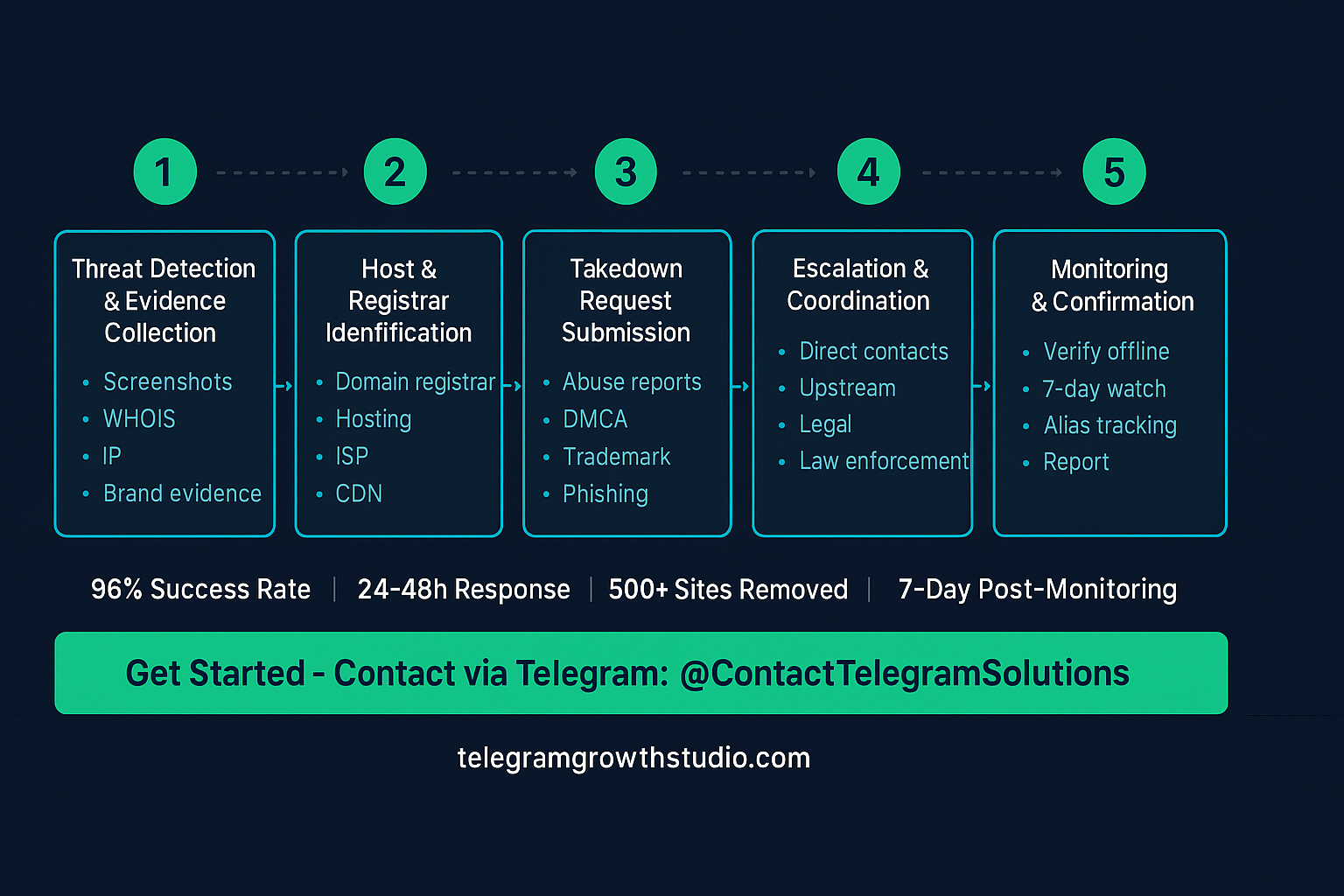
Stage 1: Detection and threat discovery
Providers scan for typosquatted domains, compromised websites, lookalike TLDs, and brand-term abuse across search engine ads, social media, SMS, and email abuse boxes. Red Points processes 2.7 billion monthly data points to surface candidates in near real time. Independent brand owners typically learn about a threat through customer complaints or Google Safe Browsing warnings — usually 24 to 72 hours late.
Stage 2: Verification and evidence capture
A domain alone is not proof. Verification combines link following, credential-stuffing tests, fuzzy logo matching, and OCR on page content. Providers produce an evidence pack containing URL, HTTP headers, WHOIS data, timestamped screenshots, and a chain-of-custody log. Cloudflare, Cloudflare Registrar, and most large hosts reject takedown requests that omit this evidence within the first exchange.
Stage 3: Abuse channel submission
The evidence pack is routed to the correct abuse channel: the host's abuse@ address, the registrar abuse contact, Cloudflare's abuse form, or a platform-specific portal. Experienced teams hold pre-negotiated escalation paths with tier-one hosts, which is why specialist firms close cases that individual reporters cannot.
Stage 4: Escalation and legal action
If a registrar or host does not respond within 24 to 72 hours, the case escalates. Options include CDN-level blocking through Cloudflare's trust and safety team, ICANN complaints against uncooperative registrars, UDRP arbitration for trademark-infringing domains, and cease-and-desist letters with DMCA takedown notices. UDRP filings cost roughly $1,500 to $4,000 and take 60 days, making them a last resort.
Stage 5: Verification and re-emergence monitoring
Removal is confirmed across DNS, HTTP status, Google cache, and Wayback Machine. Because attackers routinely spin up typosquatted clones within 6 to 24 hours, continuous monitoring flags re-emergence on new infrastructure. Red Points notes that 95% of its high-volume customers rely on automated monitoring rather than reactive reporting.
What Types of Malicious Sites Need Takedown Action?
Different threats require different legal and operational levers. A phishing website takedown uses fraud and ToS reporting; a DMCA case uses copyright law; a counterfeit listing uses trademark enforcement. Choosing the wrong path is the most common reason takedown requests are rejected on first submission.
| Threat Type | Legal / Policy Basis | Typical Channel | Median Time |
|---|---|---|---|
| Phishing / credential harvesting | Fraud, host ToS, Safe Browsing | Host abuse + Google Safe Browsing + APWG | 1.9 – 24 hours |
| Scam website (fake shop, investment scam) | Consumer-protection law, host ToS | Host abuse + registrar + ASIC / FTC report | 24 – 72 hours |
| Brand impersonation / typosquatting | Trademark, UDRP, host ToS | Host abuse + UDRP + Cloudflare trust & safety | 3 – 14 days |
| DMCA website takedown (copyright) | Digital Millennium Copyright Act §512 | DMCA takedown notice to host / platform | 24 – 72 hours |
| Counterfeit e-commerce listing | Trademark, marketplace policy | Marketplace portal + image fingerprinting | 24 hours – 7 days |
| Dark web leak / marketplace | Policy + ISP pressure | Law enforcement + hosting provider | 7 – 30 days |
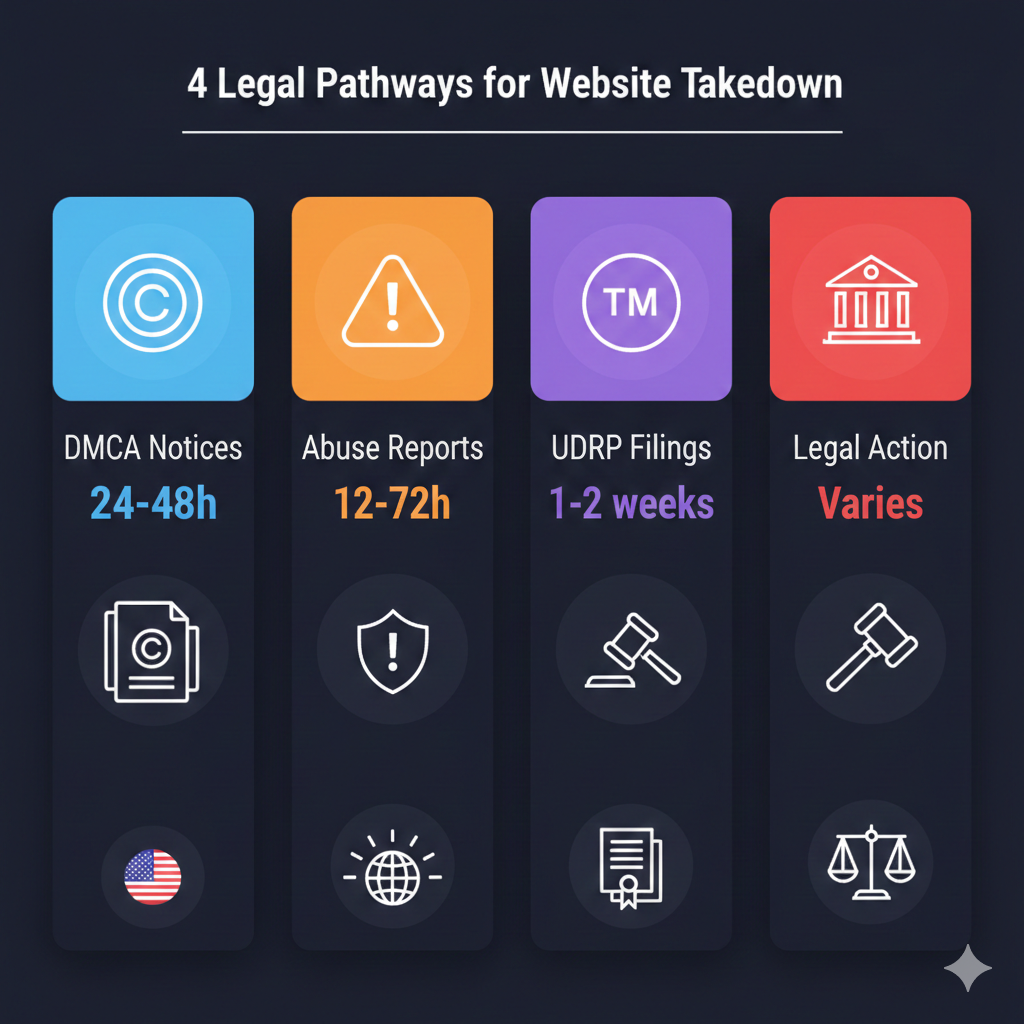
Brand owners dealing with multi-platform attacks often need parallel paths. A fake storefront can simultaneously trigger a trademark claim at the registrar, a DMCA claim at the host for copied product photography, and a fraud report to the FTC. This parallelism is a core reason enterprises hire specialists instead of handling website takedown requests internally.
Manual vs Automated Website Takedown: Which Is Right for You?
Manual takedowns work for one-off incidents where you know the attacker, have clean evidence, and can wait 3 to 7 days. Automated website takedown becomes necessary once you face more than one or two threats per month, or if your brand attracts high-volume phishing campaigns.
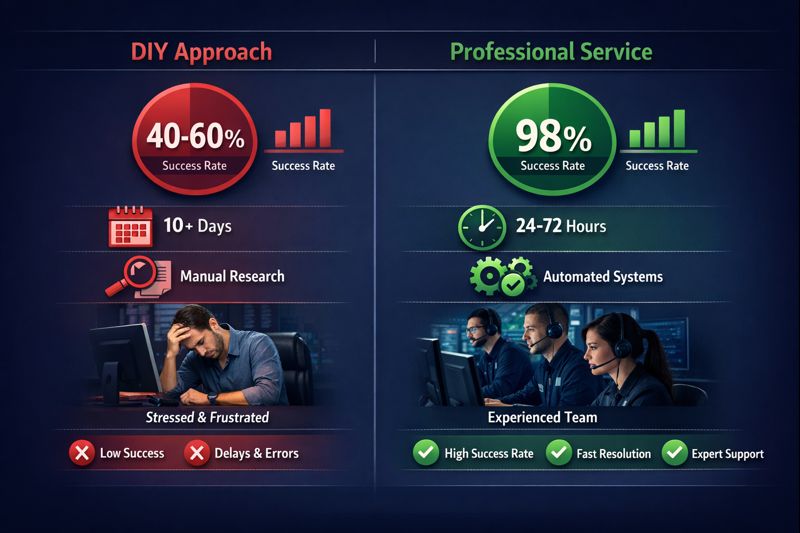
When manual takedown makes sense
Single incidents where a copyright-infringing blog republished your article, a disgruntled former employee built one attack page, or a clearly identifiable typosquat hit one domain. A brand owner with a clean DMCA claim and a cooperative US host can close the case in 24 hours for zero budget by using Google's DMCA removal form and Cloudflare's abuse channel.
When automation becomes mandatory
Once monthly attack volume exceeds 10 to 20 URLs, manual work breaks down. Automation collapses detection, validation, and submission into a single API call, moving through Stage 1 to Stage 3 of the process without human triage. Bolster describes the trade-off in its manual-takedown field guide: "research, evidence collection, outreach, waiting, escalation — and repetition. It can work, but it's far from efficient."
Hybrid managed services — the Removal.buzz model — combine automated detection with human legal judgment for the 15 to 20 percent of cases that cannot be resolved by policy alone. That pattern matches how Check Point sustains a 96% quarterly success rate across 10 consecutive quarters.
Why Do DMCA Website Takedown Notices Fail So Often?
A DMCA website takedown notice under Section 512 of the Digital Millennium Copyright Act is one of the most powerful US enforcement tools — but it fails the first time in an estimated 40 to 55 percent of cases. Three errors dominate that failure rate.
The first error is scope. DMCA applies only to copyrighted works: articles, photos, videos, software code, and audio. It does not apply to trademark violations, brand impersonation without copied content, or general fraud. Filing DMCA against a phishing page with no copied material gets the notice rejected and can expose the filer to Section 512(f) penalties for material misrepresentation.
The second error is the missing penalty of perjury statement. A valid DMCA notice must include a sworn statement that the information is accurate and the filer is the rights holder or authorized agent. The Copyright Alliance DMCA guide lists this as the most frequently omitted element.
The third error is ignoring the counter notice risk. The accused party has 10 to 14 business days to file a counter notice, at which point the host is legally obligated to restore the content unless the original claimant files a federal lawsuit. Brand owners who cannot follow through with litigation should combine DMCA with trademark and ToS claims rather than relying on copyright alone.
How Do You Write a Strong Website Takedown Request?
A strong website takedown request contains seven elements. Missing any one of them can stretch a 24-hour case into a 14-day grind.
- Full URL and timestamped screenshot. Include the exact path, query parameters, and a server-signed screenshot showing the malicious content.
- Description of the harm. Concretely state the violation — credential harvesting, trademark impersonation, counterfeit sale, copyright infringement.
- Proof of ownership or authority. Trademark registration numbers, copyright registration, or brand documentation.
- WHOIS lookup for the target domain. Confirms the registrar and hosting relationship and signals that you have done your homework.
- Specific remedy requested. Page removal, domain suspension, DNS null-routing, or search-engine deindexation.
- Good-faith and accuracy statement. The DMCA penalty-of-perjury clause for copyright cases; equivalent good-faith language for ToS cases.
- Contact information and preferred escalation path. A real name, role, and response address — generic
info@senders are deprioritized by most abuse desks.
Enterprise takedowns slow down due to routing mistakes and inconsistent evidence, not because threats are hard to spot. Strong execution depends on structured provider submissions, fast escalation paths, and outcome tracking.
— Bolster AI, Website Takedown Field Guide, 2026
What Evidence Do Hosts and Registrars Actually Need?
Every abuse desk has its own threshold, but the evidence checklist that triggers first-pass acceptance is consistent across Cloudflare, Namecheap, GoDaddy, Hostinger, and the large ICANN-accredited registrars.
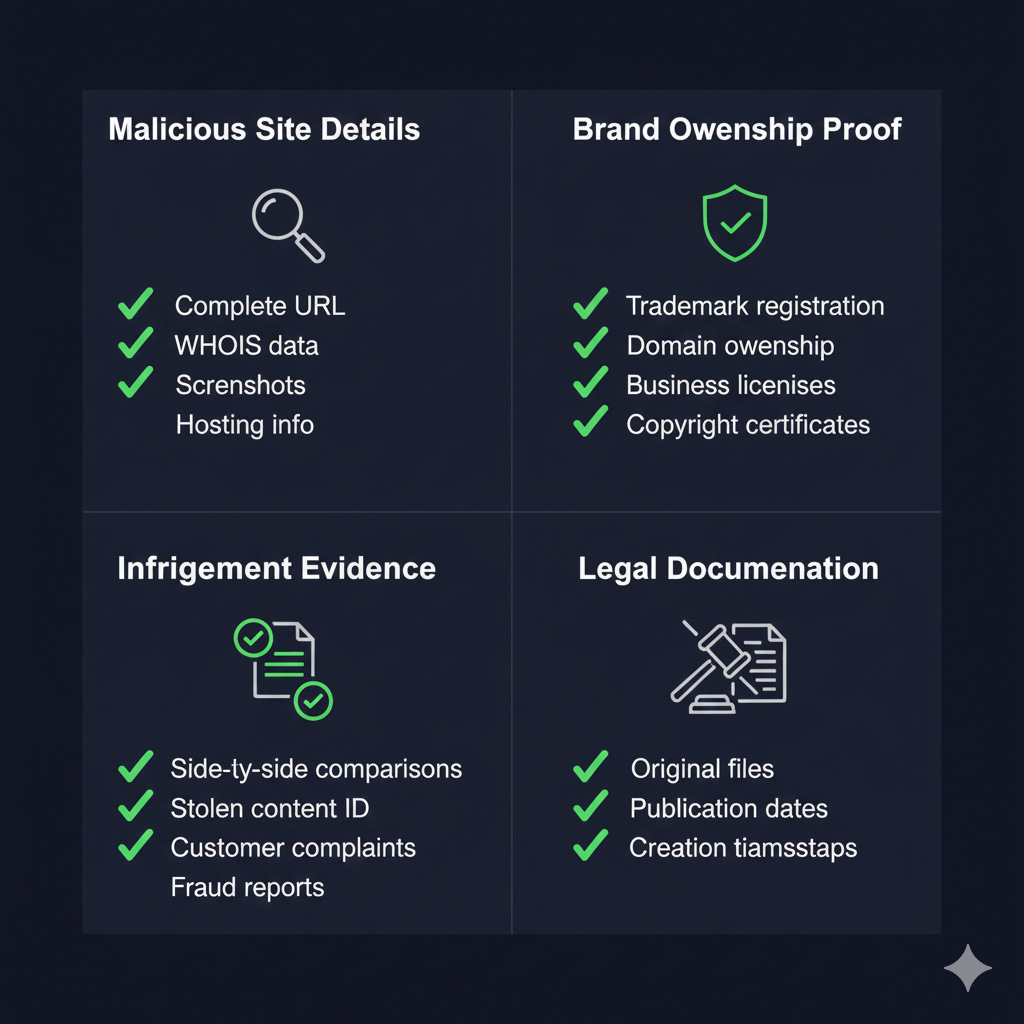
The minimum evidence pack includes six items. First, the complete URL with any redirect chain. Second, a full-page screenshot with a visible timestamp and browser URL bar. Third, the HTTP header trace showing the real server response. Fourth, the WHOIS or RDAP record identifying the registrar and abuse contact. Fifth, proof of the copyright infringement, trademark, or fraud — for example, a side-by-side comparison of the impersonated brand assets. Sixth, a chain-of-custody log describing when and how the evidence was captured.
Professional services add two more items that tip borderline cases. They include a real-time Google Safe Browsing lookup showing the site is already flagged, and an APWG confirmation number. Both signals tell the host that the takedown is part of an industry-coordinated response, not a one-off complaint.
How Long Does a Website Takedown Take in 2026?
Takedown speed depends on who you are, which host holds the site, and how well you prepared the evidence. Published 2025–2026 benchmarks show an enormous spread.
| Provider / Channel | Median Takedown Time | Success Rate | Source |
|---|---|---|---|
| Netcraft managed service | 33 minutes – 1.9 hours | ~95–96% actionable reports | Netcraft 2026 platform data |
| PhishFort | 4 – 6 hours | 99%+ | PhishFort capability page |
| Check Point External Risk | under 24 hours | 96% (10 consecutive quarters) | Check Point managed takedowns |
| Bolster automated platform | 6 – 12 hours | 99%+ | Bolster product data |
| Self-service DMCA (cooperative host) | 24 – 72 hours | 55–70% | Copyright Alliance |
| Self-service abuse report (offshore host) | 5 – 14 days | 30–45% | Bolster field guide |
| UDRP arbitration | 45 – 60 days | 85%+ when filed correctly | ICANN UDRP statistics |
| Removal.buzz managed | 24 – 72 hours | 92%+ | Removal.buzz case data |
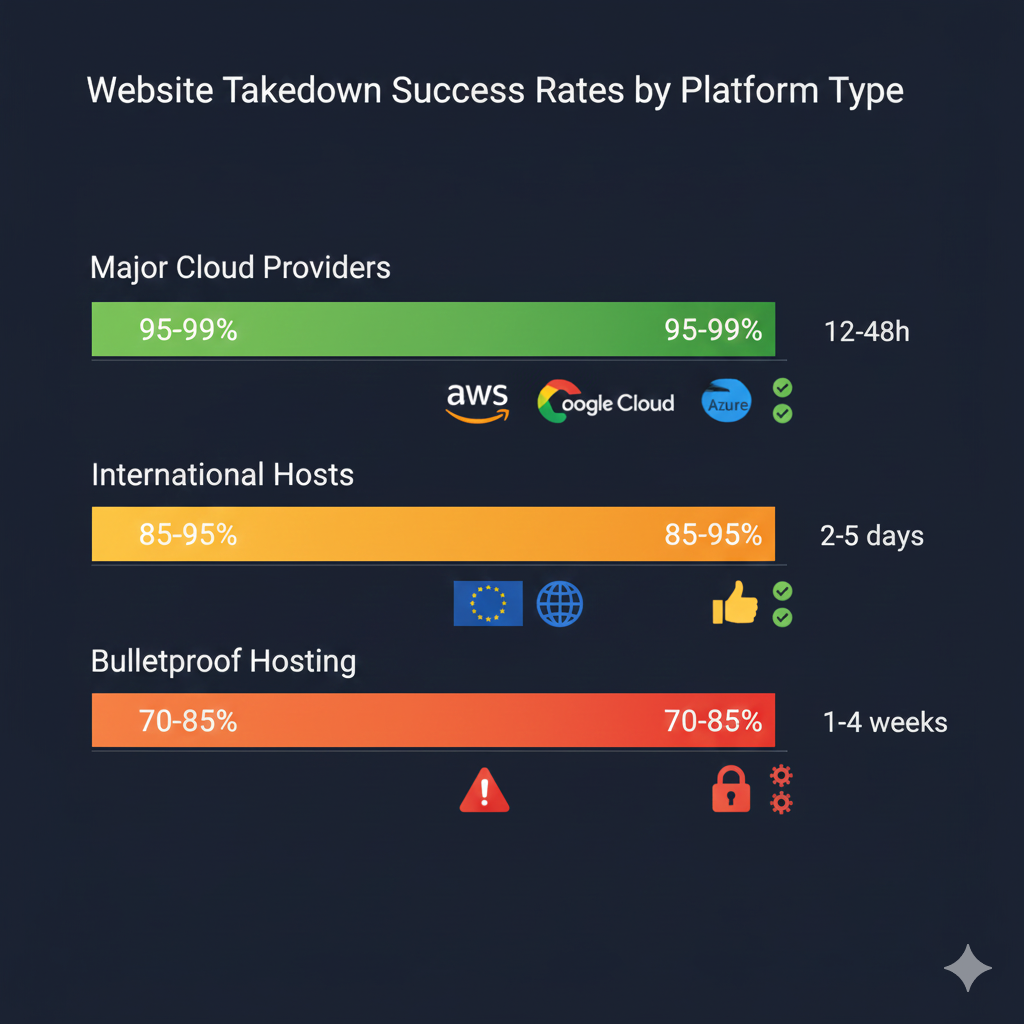
📊 500+ Cases · 92%+ Success Rate · 72-Hour Refund Guarantee
Every website takedown case is backed by a 72-hour refund guarantee. Evidence-based enforcement across 15+ registrars, hosts, and CDNs.
What Do Website Takedown Services Cost?
Pricing for website takedown services splits into three models: per-case, subscription, and enterprise managed. Reviewing recent 2025–2026 provider disclosures, published case studies, and Reddit threads on r/cybersecurity, these three bands are consistent.
| Model | Typical Price | Best For | Limits |
|---|---|---|---|
| Per-case managed takedown | $150 – $1,500 per case | SMBs and one-off incidents | No monitoring, reactive only |
| Subscription (100–500 takedowns/year) | $1,500 – $5,000 /month | Growing brands, regional banks | Usually capped, overage fees |
| Enterprise managed (unlimited) | $5,000 – $30,000+ /month | Global brands, fintech, SaaS | Annual commitment, SSO setup |
| DIY DMCA + abuse reports | $0 | Isolated copyright cases | 55–70% success, 3–14 day SLA |
| UDRP arbitration | $1,500 – $4,000 filing | Domain recovery only | 45–60 day process |
The per-case price varies with host cooperation. A cooperative US host with a clean DMCA claim closes for the minimum band. An offshore host behind Cloudflare requiring registrar escalation, trademark filings, and investment scams paperwork can triple the fee. Removal.buzz publishes flat per-case pricing and reviews each case against a fixed checklist before quoting.
How Does Takedown Enforcement Work in Australia and the EU?
The regulatory landscape varies sharply by jurisdiction. Website takedown Australia enforcement is led by two agencies — ASIC for financial scams and the eSafety Commissioner for non-financial abuse — plus private specialists.
ASIC launched a dedicated website takedown capability in 2023 and disrupted more than 2,500 investment-scam and phishing sites in its first year, a figure that crossed 10,000 sites by late 2025. For takedown scam website Australia cases, victims can report directly to Scamwatch, which forwards cases into the ASIC enforcement pipeline. Private providers such as Cybertrace and Brandsec run parallel commercial operations for brand-impersonation cases outside ASIC's remit.
In the European Union, the Digital Services Act forces large hosting providers to maintain "notice and action" mechanisms with strict response SLAs — typically 48 hours for clearly illegal content. The notice-and-takedown framework is the EU equivalent of the US DMCA and extends beyond copyright into consumer fraud, hate speech, and counterfeit goods.
For takedown impersonation website Australia cases that mix copyright, trademark, and fraud — for example a fake financial-advice domain using a real firm's logos — the fastest path is a parallel filing: ASIC for the financial fraud component, the host for ToS, and an Australian trademark claim for the branding. This multi-lane approach is one of the reasons Australian enforcement is among the fastest globally for financial scams.
What Role Do the FBI and Law Enforcement Play in Website Takedowns?
An FBI website takedown is a different beast from a commercial takedown. The FBI does not remove run-of-the-mill phishing sites on request. Instead, it runs coordinated operations against criminal infrastructure — Operation Endgame in 2024 dismantled more than 100 servers across six countries in a single week, and the 2023 takedown of the Qakbot botnet removed infrastructure serving an estimated one million compromised computers.
For an individual brand, law enforcement engagement is useful when the case involves investment scams with US victims, ransomware distribution, or human-rights abuses. The FBI IC3 reporting portal aggregates reports for enforcement prioritization. The UK's National Cyber Security Centre runs a similar takedown service via its Suspicious Email Reporting Service, which has removed over 200,000 scam URLs since launch.
Most brand owners should treat law-enforcement channels as supplementary. Commercial website takedown solutions close cases in hours; criminal investigations close them in months, but only when the target is sufficiently high-value to justify the prosecutorial resources.
Consistent successful takedown discourages cyber criminals from pursuing attacks against your domain. When you fight back, you become a more expensive target — making threat actors think twice.
— Netcraft Threat Detection & Takedown, 2026 platform report
Comparison: Top Automated Website Takedown Providers
The 2026 vendor landscape concentrates around six major commercial providers plus specialist regional firms. Each has a different sweet spot — enterprise scale, speed, forensic depth, or SMB affordability.
| Provider | Specialization | Notable Stat | Best For |
|---|---|---|---|
| Netcraft | Enterprise phishing takedown | 33-min median, 250+ detection proxies | Banks, fintech, global brands |
| Bolster | AI-powered automation | 6–12h removals, CheckPhish detection | High-volume brands, SaaS |
| PhishFort | Web3 & DeFi protection | 99%+ success, 29,000 sites for one customer | Crypto, Web3, exchanges |
| ZeroFox | Digital risk intelligence | Campaign-level attacker context | Enterprise with threat-intel teams |
| Red Points | E-commerce & counterfeit | 2.7B monthly data points | Retail, marketplaces, CPG brands |
| RiskIQ / Microsoft | Internet-wide attack surface | Acquired by Microsoft Defender | Microsoft-stack enterprises |
| Digital Shadows / ReliaQuest | Dark-web + takedown hybrid | Strong dark-web monitoring | Financial services, healthcare |
| Cybersixgill | Threat intel + takedown | Deep dark-web source coverage | Intelligence-led SOCs |
| Removal.buzz | Managed per-case takedowns | 24–72h SLA, 72-hour refund | SMBs, agencies, creators |
Choosing between these vendors usually comes down to three questions: how many takedowns per month, how complex the legal layer is, and whether you need dark-web and app-store coverage in addition to web. For SMBs handling 1 to 10 takedowns per month with mixed copyright, trademark, and fraud issues, per-case managed services offer the best cost-to-outcome ratio.
How Does Removal.buzz Handle Website Takedown Cases?
Removal.buzz runs a managed website takedown service focused on per-case accountability rather than volume dashboards. Every case opens with a 2-hour free assessment, followed by a flat-fee quote with a written SLA and a 72-hour refund guarantee if no progress is demonstrated.
The operational workflow
Case intake begins with the URL, target evidence, and the brand owner's proof of standing. Within 4 hours, a specialist completes the WHOIS and RDAP lookup, captures forensic evidence, identifies every applicable legal lever — DMCA, trademark, ToS, consumer protection — and drafts the submission package. Submissions go to the host, registrar, and CDN simultaneously, with social media reports filed against any linked fraudulent profiles.
What the service includes
Each managed engagement covers host and registrar abuse submissions, a DMCA takedown notice where copyright applies, trademark claims where brand assets are misused, Google Safe Browsing and APWG reporting, CDN escalation to Cloudflare and Akamai, search-engine deindexation, and 30-day re-emergence monitoring. Parallel related issues — such as impersonation accounts or reputation attacks — can be bundled with our bad review removal service or our brand SERP optimization workflow.
Adjacent cases are handled through the same team. If the attack includes a compromised Instagram account, a banned Twitter/X account, or review-platform attacks — for example on Google, Yelp, TripAdvisor, Amazon, Facebook, G2, BBB, Zocdoc, Vitals, RateMDs, or RealSelf — we run those in parallel with the site takedown so the brand damage closes in one engagement.
The Tesla Takedown clarification
A quick note for readers searching takedown tesla website or who arrived here via tesla showrooms queries: Tesla Takedown is a 2025 political protest campaign covered on Wikipedia and documented by Wired, unrelated to cybersecurity takedowns. If you are looking for the protest campaign, the resource you need is teslatakedown.com. If you are looking to remove a fake website impersonating Tesla or another brand, that is a takedown impersonation website case and falls squarely within the scope of this guide.
Website Takedown FAQs
What are the best sites to help with fake website takedown?
Free channels include Google Safe Browsing, Microsoft Defender SmartScreen, APWG, Cloudflare Abuse, and the Anti-Phishing Working Group reporting portal. Paid managed services with published success rates include Netcraft (33-minute median), Bolster (6–12 hour SLA), PhishFort (99%+ success), and Removal.buzz (24–72 hour SLA with refund guarantee). The best fit depends on volume and budget.
How do I take down a website I don't own?
You cannot take down a site you do not own unless you have legal standing — a copyright claim, a trademark, fraud victimization, or a ToS violation. The standard path is to identify the host and registrar via WHOIS, submit a takedown notice with evidence to both, and escalate to CDN, search engines, and law enforcement if they do not act within 72 hours.
Can a website takedown be reversed?
Yes, through a counter notice under DMCA Section 512(g). The accused party has 10 to 14 business days to file, and the host must restore content unless the claimant sues in federal court. This is why filing weak or unsupported DMCA notices is a legal risk — Section 512(f) penalties can apply for misrepresentation.
What is a phishing website takedown compared to a scam website takedown?
A phishing website takedown targets sites that steal credentials or financial data using fake login pages. A scam website takedown targets sites that sell non-existent products, run investment fraud, or collect fees for services never delivered. Phishing cases usually resolve in hours via Safe Browsing flags; scam cases take days because they require documented consumer harm.
How does a DMCA takedown website request differ from a trademark claim?
A DMCA takedown website notice applies to copyrighted works under US law. A trademark claim applies to brand names, logos, and protected marks and uses UDRP arbitration for domains or host-policy channels for content. Many brand-impersonation cases require both filings because attackers mix copied photos (copyright) with imitated logos (trademark).
What is an automated website takedown?
An automated website takedown uses detection engines, API submissions, and pre-negotiated abuse routes to remove threats without manual triage. Bolster, Netcraft, and Red Points each report automation handling 75% or more of submissions, with human analysts reserved for disputed or cross-jurisdictional cases.
What is a counter notice in a website takedown?
A counter notice is a sworn statement, filed under penalty of perjury, that a takedown was filed in error or that the content is legally authorized. Under DMCA rules, the host must restore content within 10 to 14 business days after receiving a valid counter notice unless the claimant files a lawsuit in that window.
Does RiskIQ, Digital Shadows, or Cybersixgill offer a fake website takedown service?
Yes, each is a recognized fake website takedown service provider with a different angle. The RiskIQ fake website takedown service is now part of Microsoft Defender External Attack Surface Management and routes removals through Microsoft's enforcement network. The Digital Shadows fake website takedown service (rebranded under ReliaQuest) pairs takedown with dark-web monitoring for financial and healthcare customers. The Cybersixgill fake website takedown service emphasizes deep dark-web intelligence and coordinates removals through partner networks rather than running direct removal operations.
How do I file a website takedown notice against an offshore host?
Skip the offshore host and go to the upstream infrastructure. Most offshore hosts still use Cloudflare, AWS, or a major CDN — those tier-one providers act on abuse within 24 to 48 hours. If the domain name was bought through an ICANN-accredited registrar, an ICANN complaint forces registrar-level action regardless of hosting location.
How often do attackers relaunch a taken-down website?
Phishing kits relaunch within 6 to 24 hours on fresh typosquatted domains in 70% of observed campaigns. This is why continuous monitoring — not one-time takedowns — is the industry standard, and why 95% of enterprise brand-protection programs bundle re-emergence detection into their takedown contracts.
Can Removal.buzz handle takedown impersonation website cases globally?
Yes. Removal.buzz handles takedown impersonation website cases across the US, UK, EU, Australia, Canada, and Asia-Pacific markets, coordinating with ICANN-accredited registrars, tier-one hosts, and major CDNs. Cross-border cases typically resolve within 72 hours when evidence is complete.
Closing the Loop on Website Takedown Solutions
Website takedown solutions have matured from copyright-era DMCA notices into multi-lane enforcement programs spanning hosts, registrars, CDNs, search engines, and law enforcement. The 2026 benchmarks are clear: professional providers close 92% to 99% of cases within 24 to 72 hours, while self-service attempts average 3 to 14 days at 55% to 70% success. Re-emergence monitoring — not the first takedown itself — is the factor that keeps attackers off your brand long-term. For a single incident, a well-crafted DMCA or abuse report can do the job free. For anything larger, a managed service built around flat per-case pricing, evidence-first submissions, and continuous monitoring will close cases faster and cost less than the fraud losses it prevents.
🚀 Every Hour a Fake Site Stays Up, You Lose Customers. Start Today
Get a detailed strategy, timeline, and quote within 2 hours. 72-hour refund guarantee on every website takedown case. 15+ platforms covered — registrars, hosts, CDNs, and search engines.
Related guides: Brand SERP Optimization · Bad Review Removal Service · Instagram Account Recovery · How to Unban Instagram · Twitter Unban · WhatsApp Unban · Facebook Ban Service · Instagram Ban Service · TikTok Ban Service · Twitter Ban Service · Telegram Ban Service · WhatsApp Ban Service · TikTok Enforcement · TikTok Mass Report · Twitter Mass Report · Instagram Spam Report · Instagram Mass Report · Telegram Mass Report · Telegram Report Tool · YouTube Mass Report · WhatsApp Mass Report